
California Personal Injury Surveillance Evidence: How Attorneys Build Stronger Cases
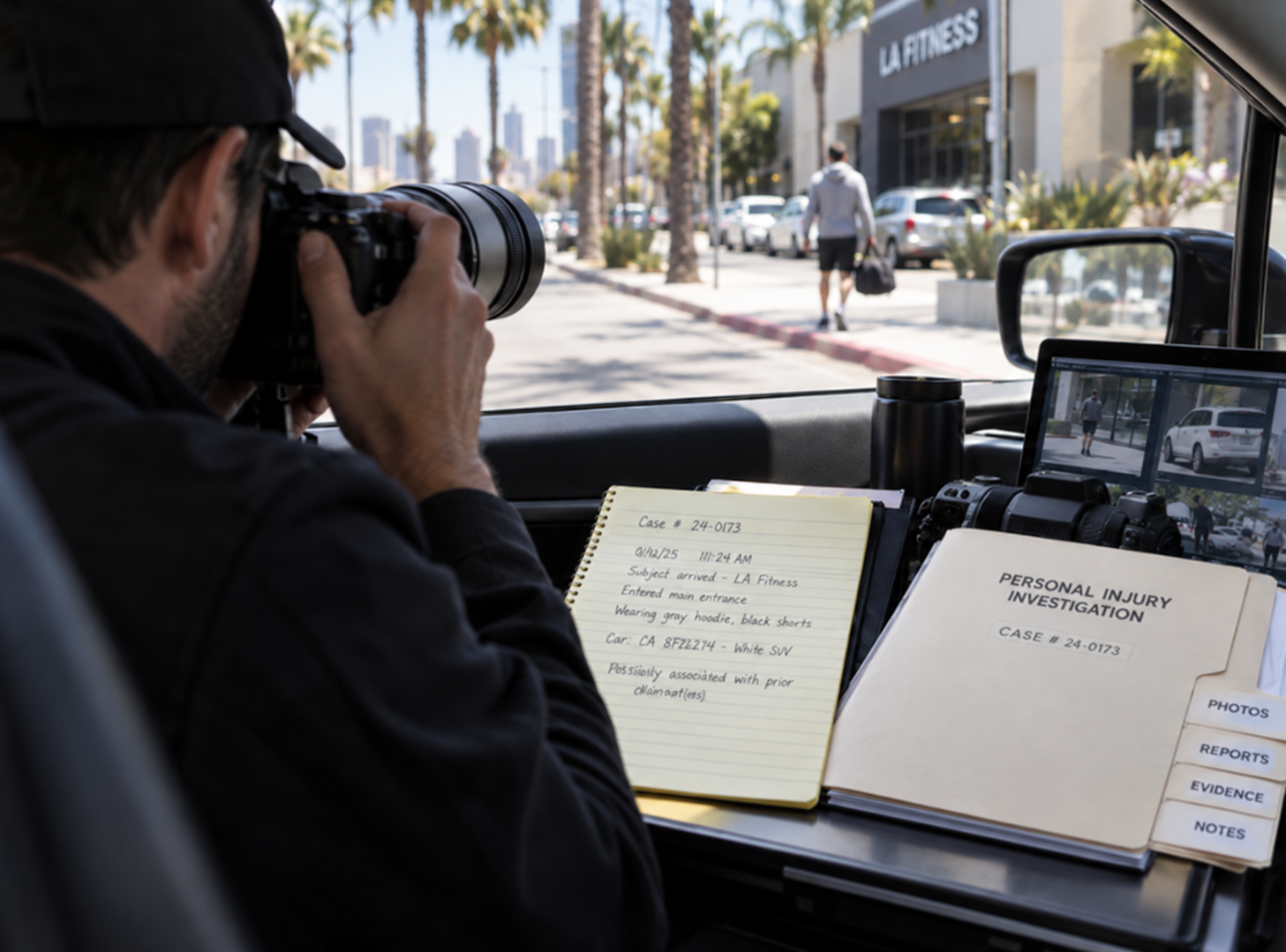
Documentation starts before the camera does — observation logs, case files, and timestamped footage are what make surveillance evidence hold up in court.
Personal injury claims don't get won on what attorneys believe happened.
Surveillance reports don't get argued away as easily as testimony does. California attorneys who build their cases on documented observation have fewer problems at the back end — no scrambling when opposing counsel challenges what a client claimed.
Attorneys who document early don't run out of options mid-case.
Why Assumptions Are Not Enough in Injury Claims
A personal injury file is mostly a collection of accounts. The claimant's account to the doctor. The witness accounts from one location at one time. Those accounts go unchallenged until someone on the other side decides to challenge them — usually when fixing the problem is hardest.
Surveillance fills in what the paper trail leaves out. It captures how a claimant moves through an ordinary day — running errands, doing yard work, loading groceries — without anyone from either legal team present to influence the outcome. A doctor visit is a performance of symptoms. An ordinary Tuesday is not.
Plaintiff attorneys use it to back up what their client reported. Defense counsel and insurers use it to check if the reported restrictions hold up. Neither side owns the footage — it shows what was observable on a given day, nothing more.
How Surveillance Documents Activity Objectively
Investigators produce video, photographs, and written logs — each item dated, each position documented. The record must meet the standards attorneys expect when preparing evidence for court.
The way surveillance is conducted matters when the evidence may be used in a legal matter. Investigators follow California privacy requirements and maintain records of their observations and methods.
Footage you can't account for doesn't make it into court. Where it was stored, who handled it, how it was transferred — opposing counsel checks all of it. A firm that treats that paperwork as secondary to the investigation itself ends up costing the attorney the evidence they commissioned.
Where Surveillance Evidence May Be Useful
Some injury claims require a closer look at what happens outside the doctor's office. A person may report certain limitations, while their daily activities may provide additional information for the case.
Back, neck, and shoulder injury claims can be difficult to evaluate because the impact of an injury is not always visible in everyday situations. Surveillance may document activity outside appointments and other controlled settings.
Workers' compensation return-to-work disputes often require a closer look at the worker's reported limitations and the activities documented during that period.
High-value cases — long-term disability, lost earning capacity, significant pain and suffering — make investigation worth the cost. The documentation produced early in the case tends to follow it all the way through, showing up in settlement talks and trial arguments alike.
Build the case around verified facts. Everything else is a guess that opposing counsel gets to challenge.
What Attorneys Should Look for When Hiring an Investigative Firm
Licensing is the baseline. California requires private investigators to hold a valid license issued by the Bureau of Security and Investigative Services (BSIS), which operates under the California Department of Consumer Affairs. Working with an unlicensed investigator creates admissibility problems and liability exposure for the attorney, not the investigator.
Trial experience as an investigator is different from general field experience. Firms that have worked cases through to verdict understand how reports are used—and attacked—in court. They write with that in mind, resulting in cleaner chain-of-custody documentation, clearer observation logs, and fewer gaps for opposing counsel to exploit.
An investigator who knows Southern California before starting a case handles it differently than one who doesn't. The neighborhoods, the access points, the traffic — none of that gets figured out on the client's time.
Raw footage handed over without documentation isn't much use to an attorney. What they need is a record that holds up to scrutiny — how it was gathered, who handled it, and why every step taken was within legal bounds.
Working with California Recovery Investigations
California Recovery Investigations works with attorneys, insurers, and businesses across Southern California. The firm's caseload covers surveillance, background investigations, witness location, and litigation support — primarily in personal injury, workers' compensation, and insurance defense matters.
California Recovery Investigations treats documentation as part of every investigation from the start. Attorneys with an active case or questions about investigative services can reach the team at calinvestigations.com/contact.